
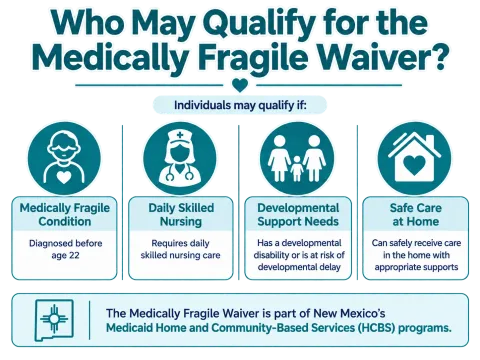
The Medically Fragile Waiver (MFW) provides home‑ and community‑based services for children and adults who have medically fragile conditions diagnosed before age 22 and who have, or are at risk for, a developmental disability or delay. Individuals who qualify for the waiver require daily skilled nursing and ongoing medical intervention to remain safe, healthy, and stable at home.
Through the MFW, families can receive comprehensive case management, in‑home nursing supports, and—in certain situations—can even serve as paid caregivers to help their loved ones thrive in their home and community. The waiver is designed to ensure children and adults with medically fragile conditions receive reliable, person‑centered care.
What the Medically Fragile Waiver Offers

Case Management
Case management is the core of the Medically Fragile Waiver. Each person is paired with a nurse case manager who works closely with their family to understand their medical needs, plan care, and coordinate all services—like nursing, therapies, equipment, supplies, and home‑health support. The nurse case manager also monitors the person’s health and safety, helps families navigate Medicaid, and makes sure services work smoothly together.
The program partners with a statewide network of nurse case management agencies, and all case managers are registered nurses living and working in the communities they serve—including rural areas—so families get support from someone who understands their local resources. Together with direct service providers, family members, and the primary care physician, the nurse case manager helps develop the Individual Service Plan (ISP), which outlines the services the person will receive and the cost of those services. Service fees in the waiver are set through agreements between DDSD and waiver providers.

Families as Paid Caregivers
The Medically Fragile Waiver recognizes that many individuals with medically complex needs rely on their families for daily, hands‑on care. Under the waiver, certain family members—including legally responsible individuals (LRIs), relatives, and legal guardians—may be paid for providing specific MFW services.
Eligible reimbursable services include:
- Respite
- Home Health Aide supports
- Private Duty Nursing (when the family caregiver is appropriately licensed)
This flexibility helps reduce turnover, increases continuity of care, and supports family caregivers who already provide intensive daily medical assistance as part of their loved one’s routine. Requirements for Payment to Legally Responsible Individuals (LRIs), Relatives and Legal Guardians

In‑Home Nursing & Therapeutic Supports
The MFW provides a wide range of clinically‑necessary services that are delivered in the home:
- Private Duty Nursing (RN or LPN)
- Home Health Aide
- Respite services
- Physical, occupational, and speech therapy
- Behavior support and nutritional counseling
- Specialized medical equipment and supplies
- Specialized Therapies
These services are designed to stabilize medical conditions, prevent institutionalization, and promote safe community living.

Equipment, Supplies & Environmental Supports
Participants may receive specialized supports such as:
- Medical supplies and equipment
- Assistive technology
- Adaptive devices
- Vehicle or home modifications when medically necessary
These supports help families maintain safety in the home and support the individual’s functional needs.
How to Get Started
Families interested in the Medically Fragile Waiver should contact DDSD or their local regional office to begin the eligibility and application process. Once enrolled, families partner with a nurse case manager to design a care plan tailored to the individual’s medical needs and family strengths.
How to Apply
-
Contact the DDSD Medically Fragile Waiver (MFW) Program to begin the application process.
- Phone: 1-800-283-8415
- DDSD staff will provide information about how to apply for the Home and Community-Based Services (HCBS) Medically Fragile Wavier and answer questions about the application process.
-
Complete the application
-
Submit the application to DDSD
- Fax: 505-841-2987
- Mail: DDSD Medically Fragile Waiver Program
5300 Homestead Road NE Suite 226
Albuquerque, NM 87110
-
Complete a phone screening
- Within 45 days a nurse case manager will reach out to the applicant to complete a phone screening to assess if they meet the criteria for eligibility to the Medically Fragile Waiver.
- If applicant meets criteria, DDSD will send an allocation letter and Primary Freedom of Choice.
-
Choose the Medically Fragile Waiver
- A nurse case manager will provide guidance and assistance to help the applicant understand the additional medical and financial eligibility requirements necessary to receive Medicaid waiver services and assist them throughout the Medically Fragile Waiver planning process including identifying the applicant’s needs, goals, preferences, and developing their Individual Support Plan (ISP).
Choosing Providers
You have a choice of MFW Providers in your service area. Your choice will be documented on the Secondary Freedom of Choice form provided by your MFW nurse case manager. You can use the How to Select a Home Health Agency to learn about things to consider when choosing a provider.
If you are interested in becoming a PROVIDER for the DD Waiver program, please visit our Provider Enrollment webpage.
Access, Navigation And Participant Support
DDSD’s access and navigation services help individuals and families understand their options and get connected to the supports they need. From applying for the DD Waiver and completing required screenings to comparing providers and resolving concerns, these tools make it easier to enter the system, make informed choices, and get help when questions arise.
Access & Intake Services (Including PASRR)
Assistance with DD Waiver applications, eligibility determinations, and PASRR screenings for nursing‑facility admission.
Provider Selection Tools
Resources that help individuals and families compare provider options and choose services that best fit their needs and preferences.
Office of Constituent Support
Support for navigating services, resolving concerns, accessing referrals, and improving communication among care teams.
Reporting Issues or Concerns
If you suspect abuse, neglect, exploitation, or a health‑care facility violation, you should report it right away. HCA's Division of Health Improvement (DHI) will investigate, address unsafe conditions, and make sure facilities and caregivers follow the safety and quality standards designed to protect the people they serve.


Resources & Forms
- Requirements for Payment to Legally Responsible Individuals (LRIs), Relatives and Legal Guardians and Q & A
- LRI Information Form
- Medically Fragile Waiver Service Standards
- DDSD Master List of Acronyms
- DDSD Master List of Definitions
- University of New Mexico Center for Development and Disability
- Medically Fragile Case Management Program at the University of New Mexico Center for Development and Disability
- Information Network Library - University of New Mexico Center for Development and Disability
- Ready Emergency Preparedness for Individuals with Disabilities